
Please follow @underthestars_bygirloutside
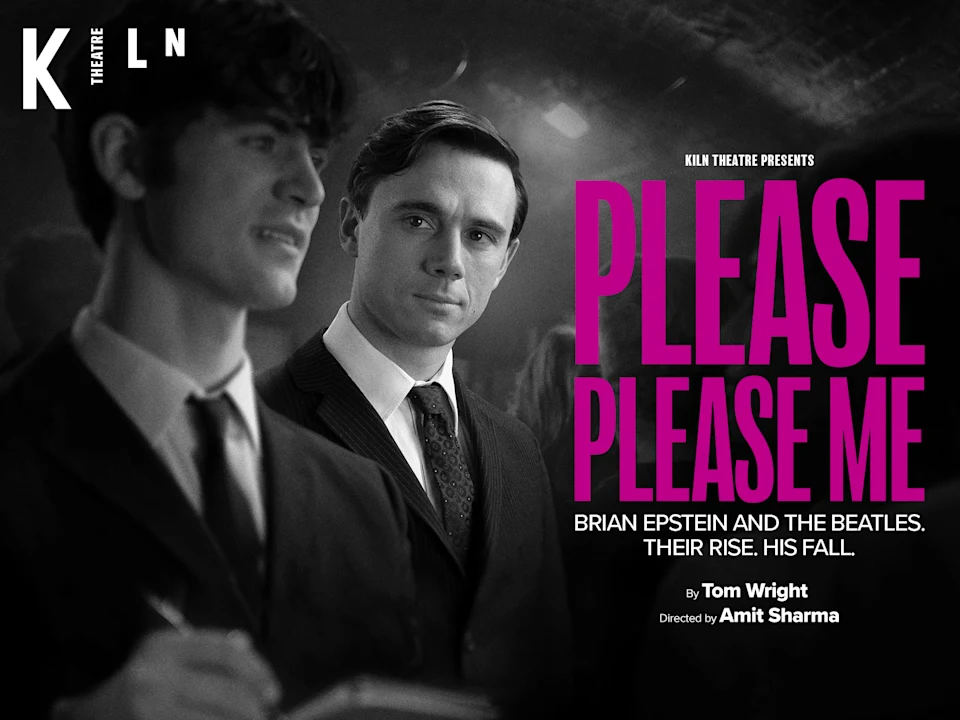
At first glance, Please Please Me at the Kiln Theatre might sound like another Beatles nostalgia piece, a trip through Liverpool accents, mop tops and wall-to-wall hits. Instead, playwright Tom Wright delivers something far more intimate and psychologically impressionistic: a study of Brian Epstein, the “Fifth Beatle”, and the hidden loneliness behind one of the greatest cultural revolutions in modern history.
For those less familiar with Epstein’s story, his importance to The Beatles is difficult to overstate. A young Jewish businessman from Liverpool, Epstein managed the family record store empire, NEMS, within a respectable and tightly controlled family world before discovering the Beatles at the Cavern Club in 1961. At the time, they were a rough-edged local band shaped by the chaos of Hamburg clubs and Liverpool nightlife. Epstein saw something extraordinary in them. He refined their image, introduced the famous suits and synchronised bows, secured crucial recording opportunities and helped transform four working-class Liverpool musicians into polished global icons. In many ways, he helped invent the blueprint for modern pop stardom itself.
Yet while Epstein became enormously successful professionally, his personal life was far more complicated. Homosexuality remained illegal in Britain throughout much of his lifetime, and Wright’s play repeatedly returns to the shame, secrecy and emotional isolation shaping Epstein’s inner world. Here was a man helping usher Britain into a new age of freedom and cultural liberation while remaining trapped behind carefully maintained facades himself. The production repeatedly hints at the tension between the respectable Epstein family environment and the hidden private life Brian was forced to navigate beneath it.
Even before the curtain rose, the production’s intent was quietly signposted through a haunting pre-show soundtrack of wistful crooner ballads including When You Lose The One You Love by David Whitfield and I’ll Always Be in Love with You and Skylark by Michael Holliday. These songs of longing, emotional restraint and unreachable devotion create the atmosphere of a Britain just before the Beatles exploded everything open: a world of coded emotions, polished surfaces and hidden lives. The playlist feels less like nostalgia and more like Brian Epstein’s private emotional soundtrack.
Wright’s programme notes make clear that this is not intended as strict historical recreation. He writes of emotional truth, memory and the unknowability of what may or may not have passed between Epstein and John Lennon during their infamous trip to Torremolinos in 1963, noting that theatre thrives in spaces where certainty breaks down. That tension between ambiguity and interpretation sits at the heart of the production.
The first half charts Epstein’s extraordinary rise with real energy. We see the ambitious young man who transformed the Beatles from rough-edged Liverpool club act into polished global phenomenon, imposing suits, discipline and refinement while simultaneously helping unleash a seismic cultural shift. The Cavern Club atmosphere is vividly evoked, and the production captures that intoxicating sense of Britain standing on the brink of reinvention. This is the story of the hidden architect of modern pop culture, a man shaping not only a band but the very idea of modern celebrity.
Interestingly, the Beatles themselves hover over the production more like ghosts than fully realised characters. Paul McCartney, George Harrison and Ringo Starr barely register directly at all, their absence becoming oddly haunting. Rather than recreating Beatlemania literally, Wright allows the band to exist as a looming cultural presence just outside the room, refracted through Brian’s memories, anxieties and desires. It is an unexpectedly effective choice, transforming the Beatles from flesh-and-blood icons into something almost mythic.
Then comes the unravelling.
The second half becomes increasingly hallucinatory and fragmented as Epstein spirals through drink, drugs, paid encounters and emotional collapse. Wright’s play leans hard into psychological impressionism here, less interested in documenting facts than inhabiting the inner chaos of a man who helped create cultural immortality while quietly disappearing inside it. The play becomes less a Beatles biography than a chamber piece about intimacy, repression and mythmaking.
At the centre is a uniformly excellent performance from Calam Lynch, known to many from the second season of Bridgerton, as Epstein. Lynch charts the character’s trajectory beautifully, moving from driven architect of Beatlemania to emotionally unravelled figure with both glamour and vulnerability intact. There is something of a young Rufus Wainwright in his appearance and energy, particularly during Act Two: intelligent, melancholic, slightly unkempt but elegant and faintly haunted. Lynch ensures Brian never becomes merely tragic martyr or historical footnote. Instead, he emerges as painfully human: ambitious, lonely, ashamed, romantic and increasingly fragile beneath the polish.
Opposite him, Noah Ritter makes a strong professional stage debut as Lennon, particularly impressive in capturing the voice and accent. However, the production’s portrayal of Lennon is perhaps its most contentious element. Here he is frequently harsh, arrogant, emotionally withholding and controlling, with relatively little warmth visible beneath the charisma. The play heavily implies Lennon as the emotional instigator and seductive destabilising force within the relationship.
More strikingly still, the production often gives the impression that Brian becomes less a genuine emotional equal than an experience for Lennon to try on before fame, marriage and fatherhood fully take hold. That imbalance hangs heavily over the play’s central relationship. Brian appears emotionally exposed and deeply invested, while Lennon frequently feels transient, exploratory and already moving toward another life entirely.
That dramatic choice creates compelling theatre but occasionally sits uneasily beside Wright’s own stated fascination with uncertainty and unknowability. Historically, the Lennon/Epstein relationship remains unresolved and contradictory, shaped as much by projection, loneliness and mythmaking as by any known facts. The play is most compelling when it allows that ambiguity to breathe rather than steering too firmly toward emotional certainty.
Still, the emotional force of the production remains undeniable, particularly in the way silence and withdrawal are used. Following the overt intimacy of the Spain scenes, Lennon’s sudden distance and emotional retreat become devastating in themselves. The man capable of managing global hysteria is reduced to anxiety over unanswered calls and vanished affection. The loneliness behind Beatlemania is rendered painfully clear.
Surrounding the central performances is a superb supporting ensemble. William Robinson, Arthur Wilson and Eleanor Worthington-Cox move seamlessly between multiple characters, creating fluidity and pace throughout. Their transformations are quick, convincing and often remarkably economical.
Worthington-Cox is especially affecting as Cilla Black, who opens and closes the play and emerges as one of its most emotionally grounded presences. Amid the speculation, obsession and emotional projection surrounding Lennon, Cilla feels refreshingly tangible and real: a loyal friend, a reminder of Liverpool roots and genuine connection. Her brief moments of singing are genuinely beautiful and quietly steal the evening.
Visually, Tom Piper’s simple but highly effective set works wonderfully within the intimate Kiln space. A huge illuminated NEMS sign looms over sparse staging and ghostly white drapes, suggesting glamour suspended above emotional emptiness. The fluidity of the design allows scenes to move rapidly through time and place without ever feeling cluttered.
Meanwhile, Amit Sharma’s slick, thoughtful direction keeps the production moving briskly across shifting decades, locations and emotional states. Despite the play’s abstract tendencies, Sharma ensures clarity and momentum rarely falter.
Ultimately, Please Please Me is less interested in Beatlemania itself than in the cost of creating it. Wright’s play asks what it cost Brian Epstein to help build a cultural revolution while remaining unable to fully inhabit his own identity. It may occasionally overstate its interpretation of Lennon and Epstein’s relationship, but it remains a compelling, stylish and deeply thoughtful piece of theatre that lingers long after the final scene fades into darkness.
UTS Rating: 
#pleasepleaseme #thebeatles #kilntheatre #johnlennon #brianepstein #cillablack
Leave a Reply