
UTS Rating: 🎭🎭🎭
They say a dog is man’s best friend, but what happens when our four-legged companions become rather more than that? A source of comfort, companionship, unconditional love and, sometimes, the very thing that keeps us going?
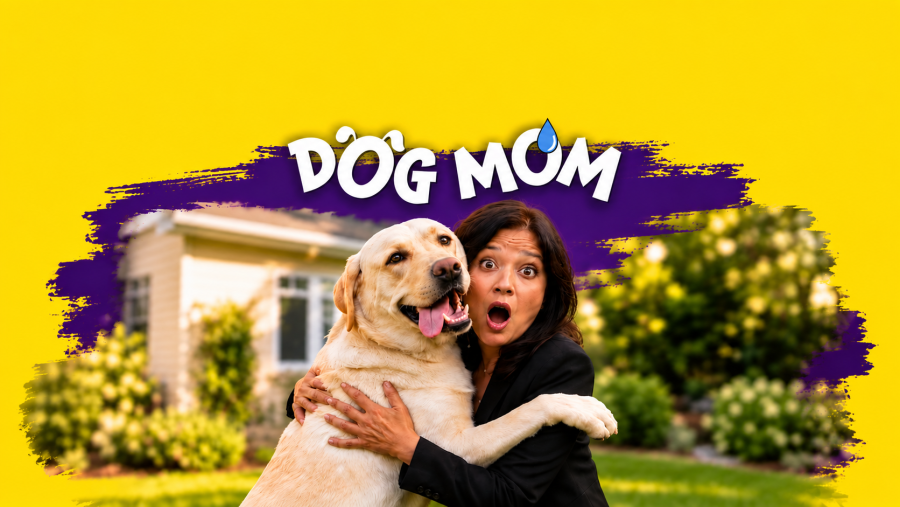
Written by Tate Elizabeth Hanyok and presented by EnActe Arts in association with Riding Lights, Dog Mom is a quirky, affectionate comedy exploring the extraordinary bond between humans and their animals. It’s funny, fluffy, occasionally frustrating and ultimately rather touching.
At the centre of the story is Sarita (Vinita Belani), a woman navigating the complications of life, relationships and expectations, who finds companionship and purpose through her relationship with her newly adopted dog, Foster. Belani gives a competent, understated performance, providing a relatively grounded presence amid the more exuberant personalities surrounding her.
And exuberant they certainly are! Patty Gallagher is quite superb as Foster, bringing her extensive experience in clowning and physical theatre to bear in a wonderfully observed portrayal. From the smallest mannerisms to the broader canine antics, she captures something instantly recognisable to anyone who has ever shared their home with a dog. It’s a first-class piece of physical comedy, frequently hilarious and thoroughly endearing.
Along the way, Sarita encounters an assortment of colourful characters, both human and canine, who help her discover that family, love and belonging can take many different forms. Tom Barnes is particularly enjoyable as Ruben, another canine companion, as well as Sarita’s ex-husband, Clay. His portrayal of Ruben is clever, funny and rather sweet, with an almost studied attention to canine behaviour that makes the character strangely believable. The physical skill involved in these performances is considerable, and both Barnes and Gallagher deserve enormous credit for making such an unlikely theatrical concept work.
The production also benefits enormously from the versatility of Jarreau Antoine, who slips effortlessly between a succession of supporting characters, bringing energy, humour and some wonderfully exaggerated characterisations to the stage. One particularly flamboyant canine creation reminded me of those gloriously pampered, rather superior poodles from old Disney cartoons. He’s terrific fun to watch, and it’s easy to see why his performance has attracted such praise.
But beneath the canine comedy lies something rather more thoughtful. One of the play’s central themes is the importance of finding your pack, those people, and animals, who understand us, support us and make us feel that we belong. Sometimes that pack consists of family, sometimes friends, and sometimes the furry creatures who share our homes and lives. Dog Mom reminds us that our pack needn’t look like anyone else’s, and that finding it can make all the difference.
This idea is particularly beautifully expressed through Nell (Joanna Holden), an interfering, opinionated New Yorker who initially comes across as rather irritating but gradually reveals herself to be one of the most compassionate and perceptive characters in the play. Holden captures the busybody exterior wonderfully, but it’s the warmth beneath it that ultimately makes Nell so memorable.
Indeed, one of the most affecting moments of the evening comes when Nell reassures Sarita that having children is not the only route to a meaningful, loving and fulfilling life. There are different ways to nurture and care, and the love we give to our animals is no less genuine simply because they happen to have four legs rather than two.
What makes the speech particularly lovely is that Nell is herself a mother, yet recognises that motherhood is neither a requirement nor the defining achievement of womanhood. As someone without children myself, I found this especially resonant. It’s a beautifully delivered moment, full of empathy and understanding, and a reminder that sometimes the quietest exchanges in a play can carry the greatest emotional weight.
Nell also becomes part of Sarita’s own expanding pack, offering friendship, support and some unexpectedly sensible advice. The play suggests that belonging isn’t necessarily something we’re born into. Sometimes it’s something we create for ourselves, one relationship at a time.
The theme of animals rescuing their humans as much as the other way around is, of course, hardly new. The extraordinary true story of James Bowen and A Street Cat Named Bob brought this very idea to a huge audience, demonstrating how the companionship of an animal can transform a person’s life. But Dog Mom finds a fresh and often very funny theatrical way of exploring that familiar emotional territory.
And perhaps that’s where its greatest charm lies. We talk endlessly about rescuing animals, giving them homes, safety and affection, but how often do we stop to consider just how much they give us in return? For those facing loneliness, loss or simply the everyday challenges of life, an animal can provide a sense of purpose, routine and unconditional love that is difficult to replicate.
All of that said, the production isn’t without its shortcomings. As accomplished as the canine performances undoubtedly are, the novelty does begin to wear a little thin as the evening progresses. What initially feels wonderfully inventive and charming becomes somewhat repetitive in the second half, and I found myself becoming just a touch irritated by the continuing doggy antics. There’s only so much canine capering one can enjoy before wishing the story would move along a little.
I also felt that the ending rather overplayed its emotional hand. Having established such a lovely, thoughtful message about companionship and the different forms that love can take, the play ultimately resorts to a fairly predictable tug at the heartstrings. It felt a little calculated, and I couldn’t help wishing the writer had trusted the emotional strength of the story without quite so much encouragement for us to reach for the tissues.
My companion, a devoted dog mom herself, was nevertheless in floods of tears by the end, so it certainly achieved its intended effect! And perhaps that illustrates something important about the production: its emotional impact will depend considerably on the experiences and attachments that each audience member brings with them.
There’s nothing particularly remarkable about the staging or design, and this isn’t a production that breaks new theatrical ground in its storytelling. But nor does it really need to. Its pleasures are simpler: accomplished performances, affectionate humour, recognisable characters and a message that will strike a chord with animal lovers everywhere.
Dog Mom isn’t a literary masterpiece, and it doesn’t pretend to be. It’s a charming, entertaining and occasionally moving piece of theatre that celebrates the extraordinary relationships we form with our animals, while gently challenging the idea that love, family and fulfilment must follow a conventional path.
Sometimes theatre doesn’t need to change the world. Sometimes it just needs to make us smile, recognise something of ourselves and perhaps appreciate our furry companions that little bit more.
A sweet, funny and thoroughly likeable evening, with plenty of heart, even if it occasionally lays the puppy-dog eyes on a little too thick.
Dog Mom runs at Southwark Playhouse, Borough, until 7th November, which tickets available here: Dog Mom – Southwark Playhouse Borough