
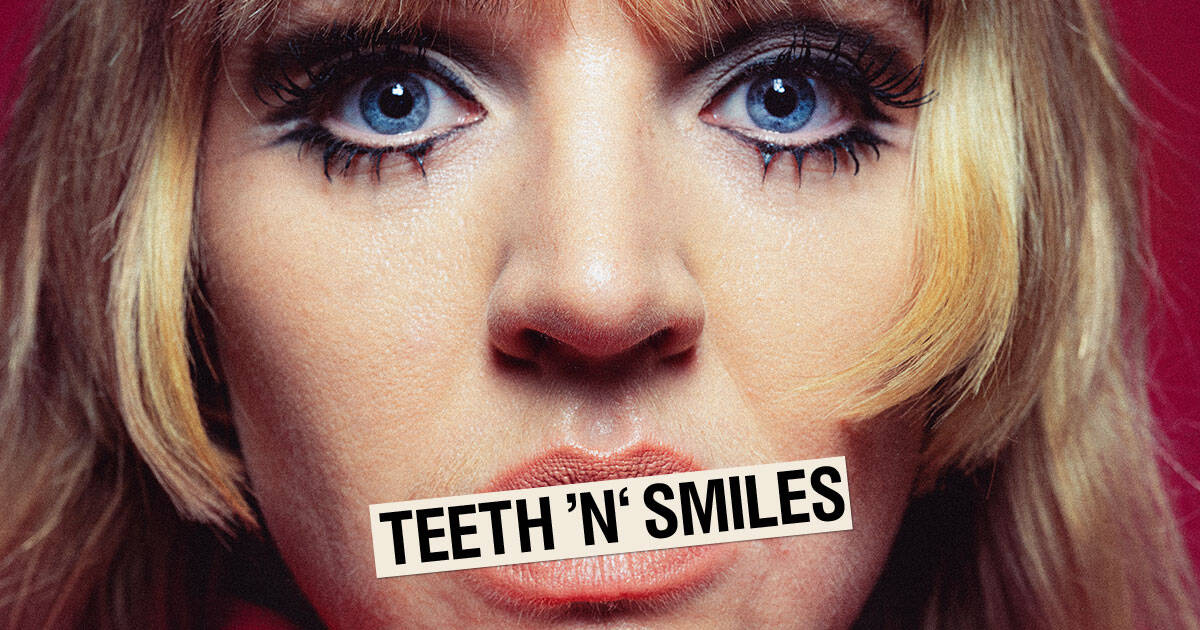
Cigarette smoke, student politics, artistic ego and emotional collapse swirl together in David Hare’s Teeth ’n’ Smiles, revived in the West End fifty years after it first shocked audiences at the Royal Court. Set during a chaotic Cambridge May Ball in 1969, the play follows struggling rock band Maggie Frisby and the Skins as the idealism of the sixties begins curdling into something far messier. Written in 1975, Hare’s play emerged from the same cultural landscape that produced punk, glam rock and the collapse of flower-power optimism, and Maggie herself has often drawn comparisons with figures such as Debbie Harry and Patti Smith: charismatic, self-destructive women trying to survive in male-dominated music scenes while everything around them threatens to implode.
This new revival clearly hopes to reconnect the play with a modern music audience through the casting of Rebecca Lucy Taylor, better known as Self Esteem. And for a while, it works.
The first half has genuine electricity running through it. Taylor gives a committed, charismatic performance as Maggie, capturing both her swagger and her slow-motion collapse. More importantly, she sounds fantastic. The songs land well, particularly the newer material written for this production, and whenever the band launches fully into performance mode the show suddenly finds clarity and pulse. If you love theatre and live music equally, there is a lot here to enjoy.
The younger cast members also bring much-needed energy and realism. Roman Asde is particularly impressive as Anson, giving one of the evening’s most believable and emotionally grounded performances. Michael Fox brings restraint and quiet melancholy to Arthur, while the rest of the band feel convincingly scruffy, weary and trapped together in that specific post-gig emotional wasteland of cigarettes, bruised egos and bad decisions at 2am.
Unfortunately, not every performance lands as successfully. Phil Daniels undoubtedly brings cultural weight and recognisable swagger to Saraffian, but the casting feels oddly outdated for a modern West End revival. Rather than disappearing into the character, Daniels often simply feels like Phil Daniels performing a familiar version of himself, and alongside some of the younger cast members the performance begins to feel curiously out of step with the production around it.
Despite its flashes of brilliance, the production ultimately collapses under its own weight.
The second half becomes increasingly muddled and dramatically unfocused. This is not an especially difficult story to follow, which makes the confusion more frustrating. Scenes blur together, emotional threads lose momentum and the production never quite finds a clear dramatic rhythm once the initial energy dissipates. The play’s themes of artistic burnout, fading counterculture and musical disillusionment remain interesting, but they are not shaped sharply enough here to sustain the running time.
Taylor cannot carry the entire production alone, however magnetic she is. She needs stronger support around her: tighter direction, clearer storytelling and, in some cases, stronger performances.
Inevitably, comparisons have also been drawn with Stereophonic, which recently occupied the same theatre and explored similarly toxic band dynamics with far greater precision and emotional depth. Teeth ’n’ Smiles has moments of raw atmosphere and musical power, but never reaches that level of cohesion.
Like the band at its centre, this production is chaotic, bruised, occasionally thrilling and ultimately unable to hold itself together.
UTS Rating: 🎭🎭
#TeethAndSmiles #SelfEsteem #DavidHare #WestEnd #TheatreReview
Leave a Reply