
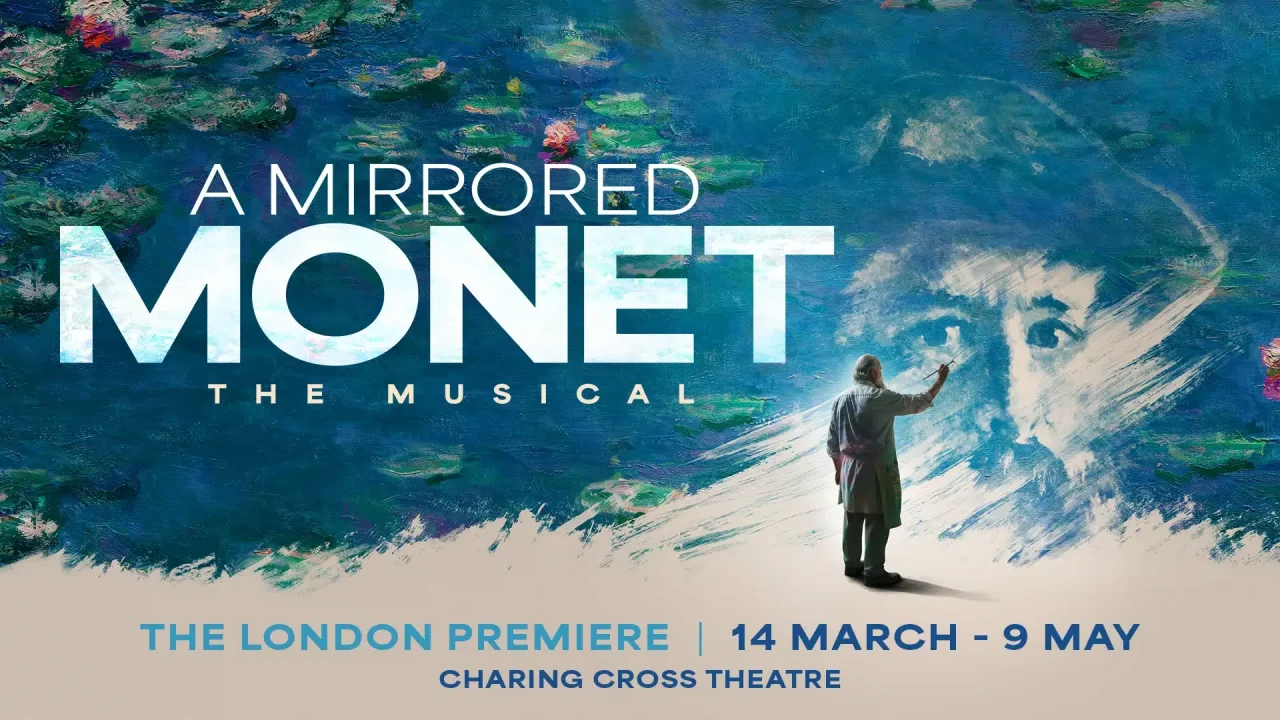
A Mirrored Monet at Charing Cross Theatre is an immersive and visually striking piece that invites its audience not simply to observe, but to step inside the world of its subject. Drawing on the life and legacy of impressionist painter Claude Monet, the production blends music, movement and impressionistic design to create something that feels less like a traditional musical and more like a living canvas.
The concept is a compelling one. With a central playing space and fluid stage design (kudos to Libby Todd and Matt Powell) the audience is drawn into the action, moving through moments that feel cinematic in their use of light, colour and sound. Blues and soft washes of colour echo Monet’s own palette, while Jodie Underwood’s lighting design is also particularly striking, shifting between softness and intensity to mirror the emotional landscape of the piece. At times it captures something fleeting and painterly, resembling reflections on water; at others, it frames the characters in moments of quiet introspection. Combined, these elements create a world that feels both gentle and immersive; one that invites you in, and quietly holds you there, drawing you into Monet’s internal landscape as much as his external life.
At its heart, however, A Mirrored Monet is less concerned with biography than with something more universal: the cost of ambition and the question of what it means to truly succeed. Through its dual portrayal of Monet – both the older, reflective artist and his younger, searching self – the piece explores the tension between external recognition and internal truth. Camille, Monet’s first wife, emerges as the emotional centre of the story – not as a counterpart to ambition, but as its quiet cost. Through her, the production gives shape to what can be lost in a life devoted to art: love, stability, and the everyday human connection that exists beyond legacy. If Monet represents the enduring pull of creation, Camille represents what is left behind in its wake.
The performances across the board are of a very high standard. Jeff Shankley, as the older Monet, anchors the piece with a beautifully textured, gravelly speaking voice and a calm, reflective presence that draws the audience in. He brings a real warmth and authority to the role and, with a CV that includes originating Greaseball in Starlight Express and Munkustrap in Cats (how cool is that?!), it’s a genuine pleasure to see him here in a later-career role that feels so well suited to him.
In contrast, Dean John-Wilson’s younger Monet brings a more searching, emotional energy, capturing the artist at an earlier, more uncertain stage of his life. Surrounding him is a wonderfully drawn circle of fellow artists – Bazille, Renoir and their mentor, Manet – creating a bohemian snapshot of the Impressionist movement in its formative years. There’s something particularly appealing about seeing that community brought to life on stage: a group of young creatives, bound together by ambition, friendship and a shared desire to break away from convention.
Aaron Pryce-Lewis, the Welsh powerhouse, as Manet, is a standout. With a commanding stage presence and a rich, resonant baritone, his performance adds both authority and warmth, and provides some of the musical highlights of the evening. Across the ensemble, the vocals are consistently strong, with a polished, high-quality feel throughout. Brooke Bazarian as Camille is particularly notable in this respect, her voice clear, expressive and beautifully controlled.
Carmel Owen’s score itself leans more towards atmosphere than melody. While it may not offer many immediately memorable or “catchy” numbers, it works effectively within the piece, supporting its reflective tone rather than competing with it. There are moments that echo the sensibility of Sondheim’s Sunday in the Park with George, an inevitable comparison, perhaps, given the subject matter, and while this production doesn’t aim for the same musical impact, it shares a similar interest in art, legacy and the inner life of the artist.
There is, perhaps, a slight sense of the piece lingering a little too long in places, with some musical numbers and passages extending beyond their natural peak. However, this never significantly detracts from the overall experience, which remains cohesive and thoughtfully realised.
Ultimately, A Mirrored Monet is a reflective, quietly moving exploration of art, memory and identity. It delivers its impact not necessarily through spectacle or immediacy, but rather through atmosphere, nuance and the questions it leaves behind.
UTS Rating: 
A Mirrored Monet continues its run at Charing Cross Theatre until 9th May 2026 with tickets available here: Charing Cross Theatre
#amirroredmonet #charingcrosstheatre #offwestend #newmusical #claudemonet
Leave a Reply