
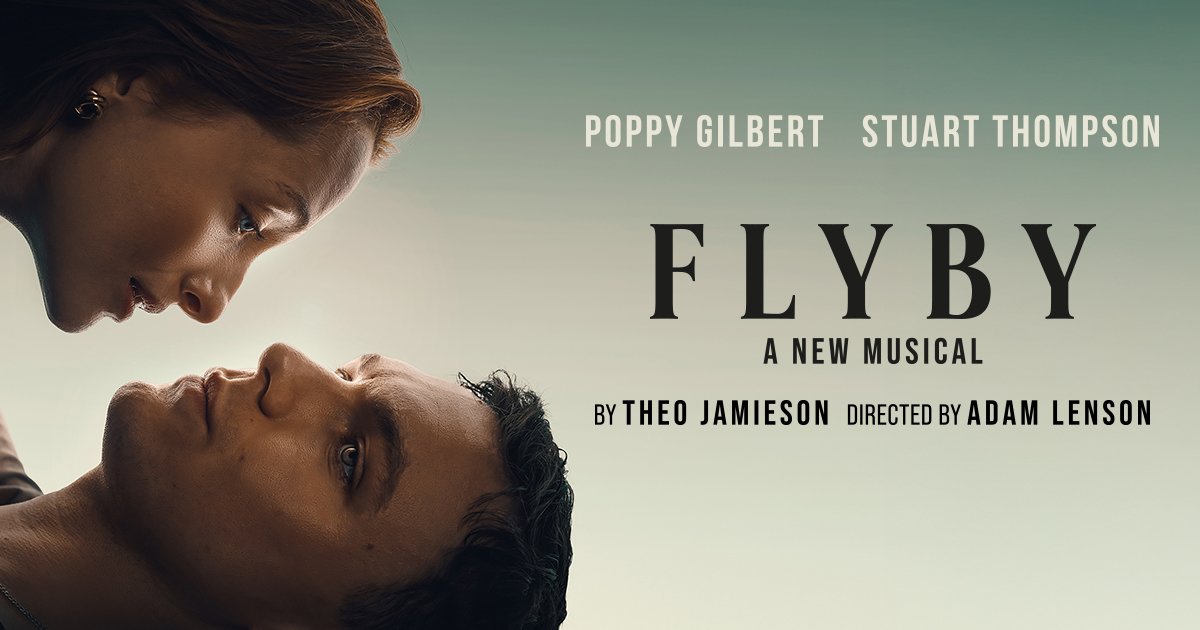
There’s something fitting about returning to reviewing with a musical called Flyby. After a pause, relaunches can feel a little like re-entry: exciting, slightly disorientating and fuelled by equal parts anticipation and nerves. It also felt entirely right that this return happened at one of my favourite London venues, the wonderfully atmospheric Southwark Playhouse.
There’s always a particular electricity to a final matinee too. Audiences arrive knowing this exact version of the show is about to disappear forever, while casts often perform with that unique mixture of freedom, exhaustion and emotional openness that only comes at the end of a run.
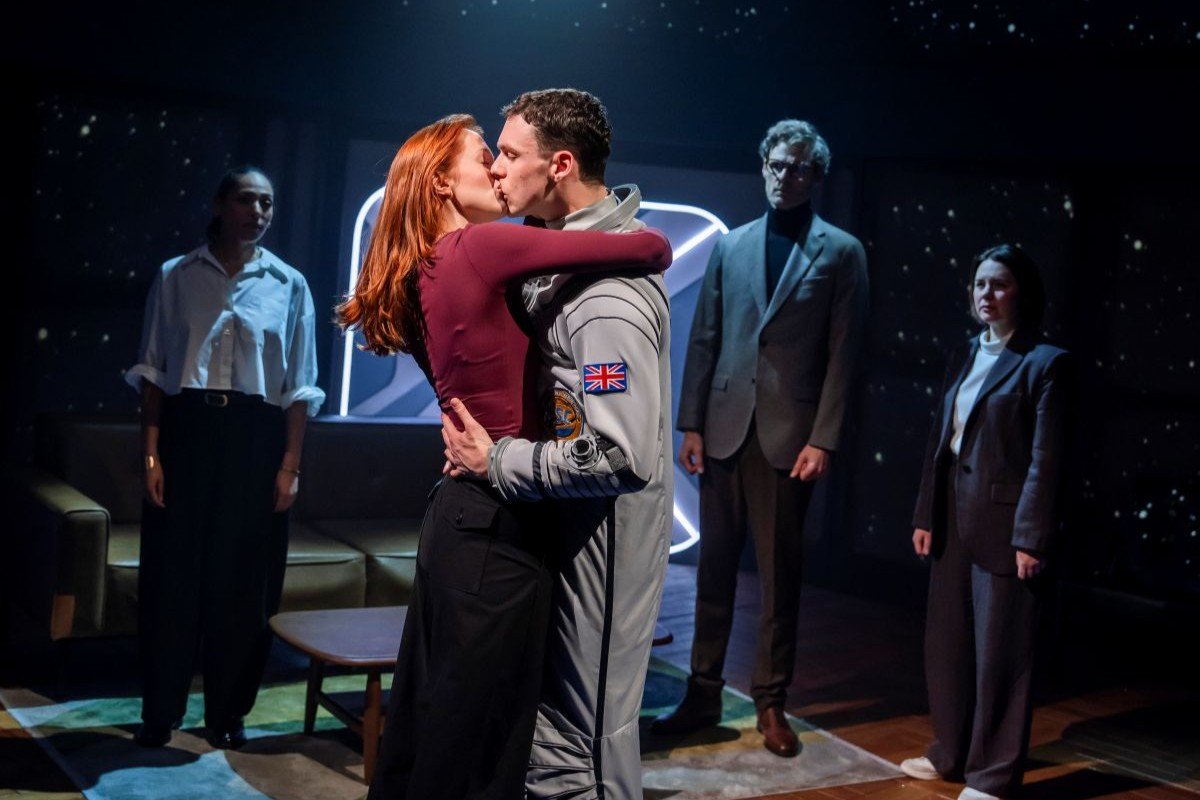
Created by Theo Jamieson and Adam Lenson and developed at the National Theatre, Flyby arrives with considerable ambition. Part psychological drama, part fractured love story and part retro-futurist sci-fi fever dream, it follows astronaut and engineer Daniel and filmmaker Emily through a relationship shaped by memory, trauma, longing and emotional distance.
The narrative unfolds in a deliberately fragmented and non-linear way, weaving together memories, interviews, imagined sequences and moments of emotional confrontation. Three narrators orbit around the central story, helping to blur the boundaries between documentary, memory and psychological interiority. At times the show feels almost less interested in literal plot than in recreating the sensation of drifting through somebody else’s emotional landscape.
Before the show even began, Southwark Playhouse’s Large had already been transformed into its world. The auditorium hummed with retro electronic chatter and R2-D2-esque spaceship noises, creating an immediate sense of immersion. The audience itself was not completely packed for this final matinee, but the house still felt warm, lively and genuinely engaged.
Visually, the production is striking. Libby Todd’s set design places a mid-century style living room inside a glowing cube-like structure which feels simultaneously domestic, clinical and cosmic. The musicians positioned in upper windows, above the action and behind the stars, become part of the visual language too, almost like observers overlooking the characters or the emotional machinery of the ship itself. In Southwark’s relatively intimate space, the production manages to feel surprisingly expansive.
And in many ways, Flyby is at its strongest when it fully embraces its sci-fi atmosphere. The imagery of space, isolation and drifting emotional disconnection is often genuinely haunting. The production creates an evocative emotional texture that lingers long after the performance finishes.
At the centre of this is Stuart Thompson’s deeply committed performance as Daniel. Thompson gives the character an openness and emotional fragility that anchors much of the show, particularly during his solo material. There is something painfully exposed about Daniel throughout, a man carrying unresolved trauma, loneliness and a desperate longing for connection. Even when the narrative itself occasionally drifts, Thompson remains compelling to watch.
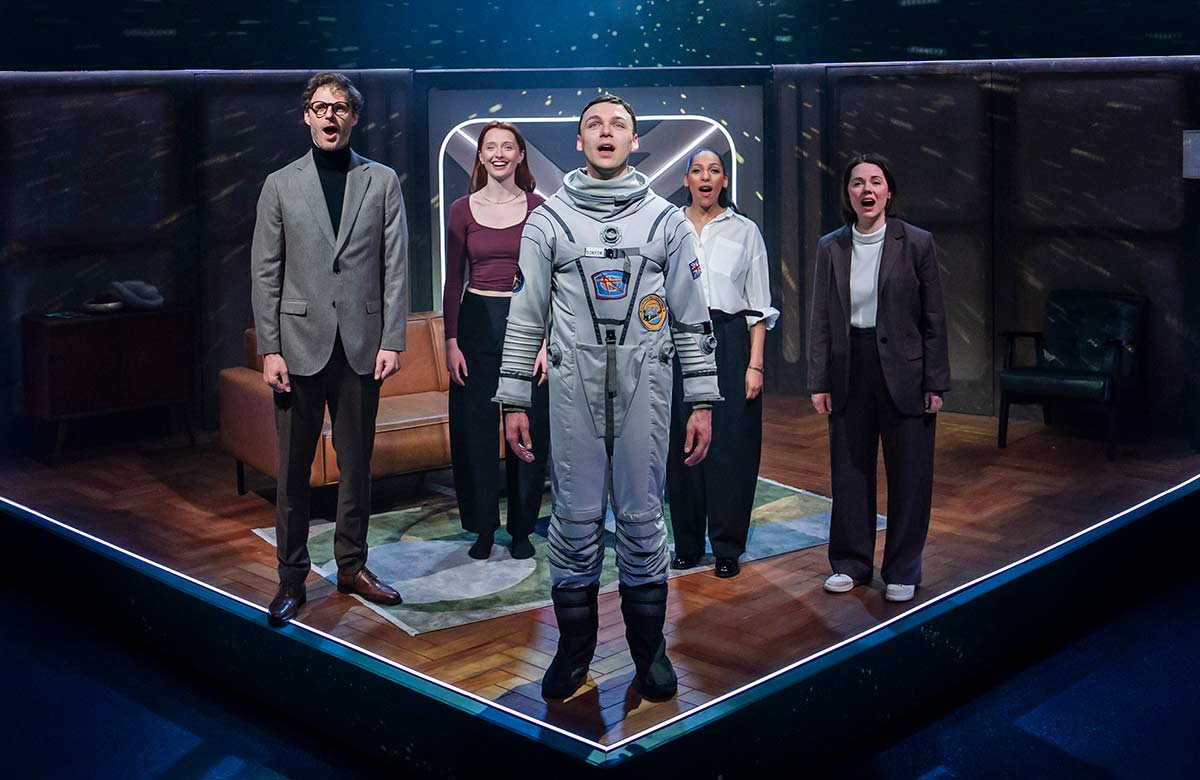
Poppy Gilbert’s Emily is more difficult to connect with, although this feels more a question of writing than performance. The central relationship is intentionally messy and volatile, but I found myself far more emotionally invested in Daniel’s internal journey than in the romance itself. Interestingly, the show’s metaphorical exploration of space and emotional isolation often proves more engaging than the actual relationship drama at its core.
That imbalance becomes increasingly apparent as the piece progresses. Flyby is rich in symbolism and atmosphere, but not all of its imagery fully lands or remains clearly anchored. The turtle motif, initially introduced through childhood memory, has clearly divided opinion, but I actually found it surprisingly effective. What could easily have tipped into something distracting instead became oddly touching and visually memorable. The turtle seems to carry multiple possible meanings throughout the piece: safety, retreat, emotional self-protection and the idea of carrying ‘home’ with you even while drifting through isolation. There is also something quietly resonant in the image of a creature instinctively navigating vast oceans, mirroring Daniel’s own search for guidance and connection across emotional and literal distance. It struck me as the kind of theatrical device that could become even more powerful on a larger stage with greater visual scale behind it.
The show repeatedly gestures towards ideas of navigation, home and guidance, particularly through its lighthouse imagery, but these themes sometimes feel more poetically suggested than fully embedded within the storytelling. This is perhaps where my feelings about the production became most mixed.
There is no question that Flyby is ambitious, intelligent and visually imaginative. Adam Lenson’s programme note explicitly states that the show is not interested in neatness or tidy emotional resolutions, and that intention is absolutely visible on stage. However, there were points where the fragmented structure and dreamlike ambiguity began to work against the production’s emotional momentum.
At one hour and forty-five minutes without an interval, the show occasionally starts to feel adrift. Certain scenes and emotional beats repeat without significantly deepening the central relationships, and there were moments where my attention began to wander despite the audience around me remaining visibly absorbed. The material arguably needs either tightening or a full two-act structure to better sustain its emotional trajectory.
Even so, there is something admirable about a musical willing to take these kinds of risks. In an era where so much theatre can feel carefully focus-grouped into submission, Flyby reaches unapologetically for something stranger, more poetic and more emotionally elusive.
I left Southwark Playhouse unsure I fully loved the show, but equally unable to stop thinking about it afterwards. Its imagery, performances and atmosphere continued to circle in my head long after the final moments.
Like space itself, Flyby can sometimes feel vast, beautiful, lonely and difficult to fully grasp. But perhaps that lingering ambiguity is partly the point.
UTS Rating: 🎭🎭🎭
#FlybyMusical #SouthwarkPlayhouse #LondonTheatre #newmusicals #offwestend
Leave a Reply