
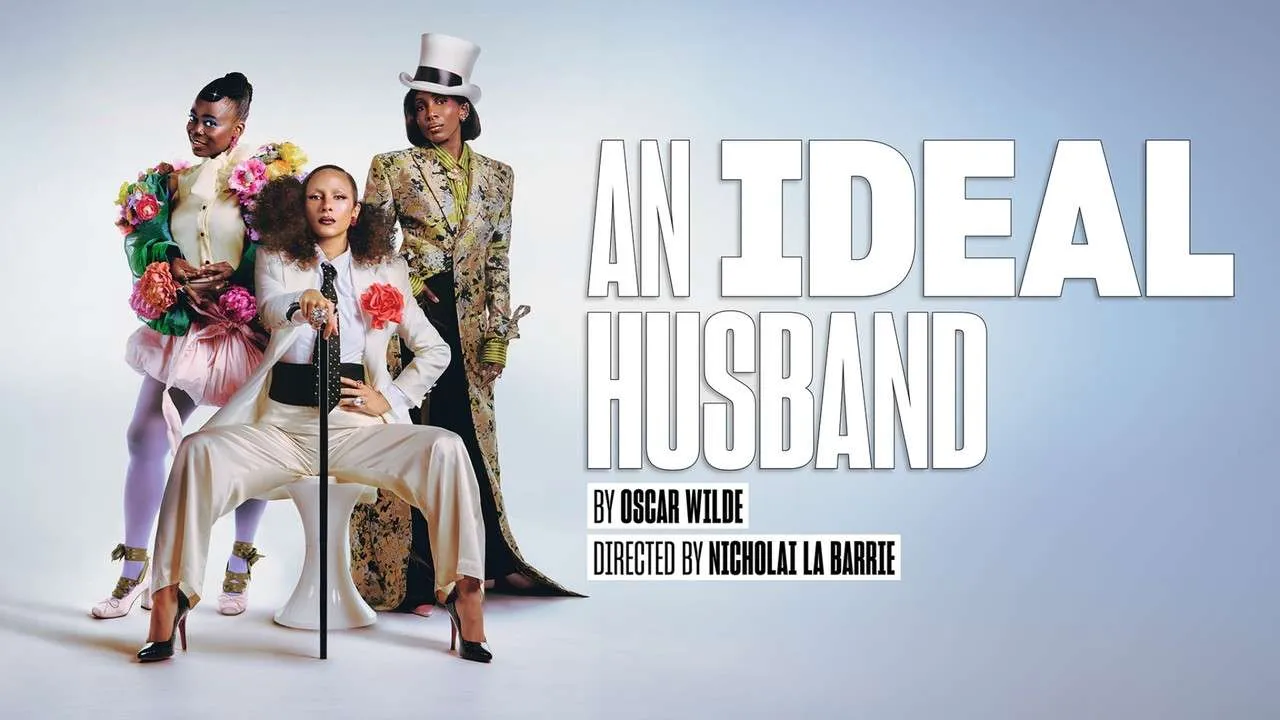
Oscar Wilde’s An Ideal Husband has always been a play obsessed with image: public morality, private compromise and the performance of respectability. Director Nicholai La Barrie’s bold new production at the Lyric Hammersmith attempts to drag those themes firmly into the present day through an all-Black cast, contemporary music, stylised movement and a visually striking modern aesthetic. The result is certainly ambitious, often entertaining and undeniably original, even if it does not always fully cohere dramatically.
From the moment audiences enter the auditorium, the production announces its intentions loudly and confidently. Contemporary R&B and neo-soul pulse through the theatre before the curtain rises, cocktails are themed around power and scandal, and the production’s visual world immediately rejects any notion of dusty heritage theatre. Instead, this is Wilde reframed through glamour, politics, celebrity culture and modern public performance.
Visually, the production is often stunning. The costumes are magnificent throughout, blending sharp tailoring with contemporary luxury and high-fashion flair. Jamael Westman’s Lord Goring in particular looks effortlessly stylish every time he steps on stage, perfectly embodying the character’s languid charm and social ease. The set design remains relatively minimal, but the lighting, choreography and physical theatre elements constantly reshape the stage around it, giving the evening a fluid, kinetic energy. At several points, movement is used extremely effectively, whether through stylised transitions, heightened ensemble work or moments where characters physically orbit one another like figures trapped within a glamorous political machine. There are also some genuinely inspired uses of music throughout, from modern Black music and dance influences to the inclusion of tracks such as Miss Dynamite, all helping to create a vibrant contemporary atmosphere that feels worlds away from traditional Wilde productions.
And yet Wilde remains stubborn material. However modern the framing, An Ideal Husband still lives or dies on precision: timing, chemistry, wit and absolute confidence with language. Too often here, the acting lacks the sharpness needed to make Wilde’s dialogue truly sparkle.
Aurora Perrineau’s Mrs Cheveley occasionally hints at the steel and sophistication the role demands, and visually she certainly fits the production’s sleek aesthetic. However, the performance never quite acquires the commanding gravitas or seductive menace needed to make the character truly formidable, leaving some of the play’s central stakes feeling less dangerous than they should. Elsewhere, several performances veer too heavily into caricature, with comedy frequently overplayed rather than allowed to emerge naturally from Wilde’s razor-sharp dialogue.
It is Jamael Westman, best known to many audiences for previously starring as Hamilton in the West End production of Hamilton, who most successfully understands the rhythms of Wilde. His Lord Goring is charismatic, relaxed and genuinely funny without ever appearing to chase laughs too aggressively. Westman instinctively trusts the text, allowing Wilde’s wit to land naturally rather than forcing it. His scenes with Mabel Chiltern, played with warmth and charm by Tiwa Lade, are easily the production’s strongest. Together they generate the chemistry, playfulness and emotional ease that much of the evening elsewhere struggles to sustain.
Chike Okonkwo also brings welcome grounding and sincerity to Sir Robert Chiltern, helping anchor some of the production’s more emotionally serious moments amidst the surrounding theatrical excess.
Interestingly, the second half proves considerably stronger than the first. Once the production finally relaxes into its own absurdity and embraces the heightened theatricality more confidently, it becomes significantly more entertaining. Certain visual moments linger impressively in the memory, particularly the wedding sequence and bursts of red confetti that transform the stage into something resembling a glamorous political fever dream. There are flashes throughout of the daring, contemporary Wilde revival this production could perhaps have become more consistently.
What ultimately prevents the evening from fully succeeding is not the concept itself, but the uneven execution. The production clearly understands Wilde intellectually, and its desire to widen access to classic theatre while reframing the play through a contemporary lens is admirable. Judging by audience reaction, many viewers were clearly having a wonderful time, particularly those perhaps newer to Wilde’s work. That accessibility and inclusivity can only be a positive thing for modern theatre.
However, the production too often mistakes noise, movement and stylisation for genuine dramatic depth. Wilde’s satire needs precision beneath the spectacle, and here the balance does not always hold.
Still, for all its flaws, this remains a genuinely interesting revival rather than a forgettable one. It may not fully succeed, but its ambition, visual flair and willingness to take risks are difficult to dismiss. In a theatrical landscape often dominated by safe revivals, there is at least something refreshing about a production prepared to fail boldly rather than succeed conventionally.
UTS Rating: 🎭🎭🎭
#AnIdealHusband #LyricHammersmith #OscarWilde #TheatreReview #LondonTheatre
Leave a Reply