
UTS Rating: 
Who owns our memories? And if technology allowed us to step inside somebody else’s most intimate experiences, would we have the right to do so?
These are just some of the fascinating questions raised by Memoriam, Noga Flaishon’s intelligent, funny and ultimately deeply affecting new play, currently receiving its UK premiere at Southwark Playhouse. Combining speculative science fiction with an intimate family drama, it explores the increasingly blurred boundaries between technological possibility, historical preservation and personal autonomy.
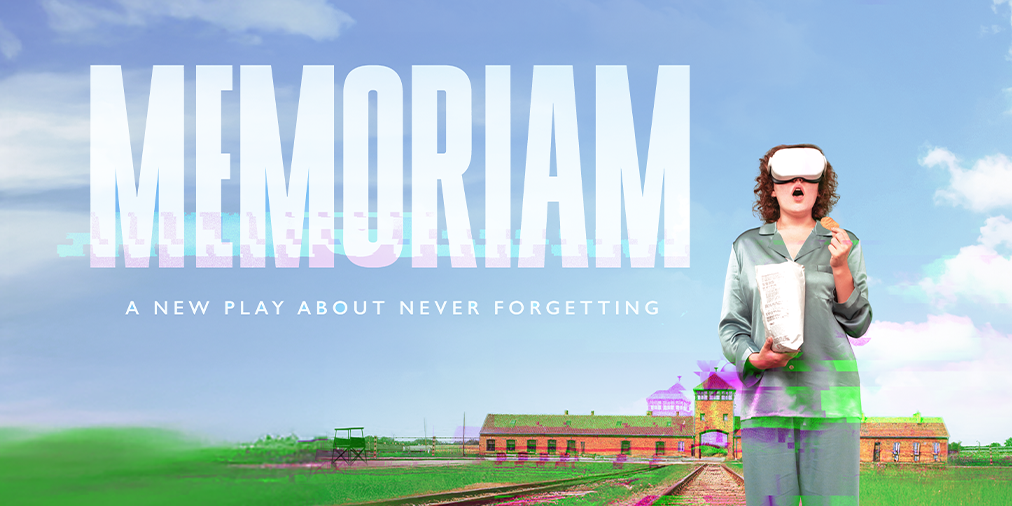
In a not-too-distant future, a company called Memoriam has developed technology capable of extracting people’s memories and allowing others to experience them firsthand. Customers can enter another person’s recollections through a sophisticated sensory process, opening up extraordinary possibilities for entertainment, education and the preservation of history. But when memories become a commodity, who decides what happens to them?
Rachel (Rachel Barry) works for Memoriam, where her ambitious boss Chris (Ben Wiggins) sees an extraordinary commercial opportunity in her grandmother Rivka (Beverley Klein), a Holocaust survivor whose memories could become an invaluable resource. With Rachel under considerable pressure at work, persuading Rivka to participate becomes increasingly important. Yet her brother David (Ashley Margolis) is fiercely opposed, believing that their grandmother’s experiences are hers alone and that her wishes must be respected.
What follows is an absorbing exploration of competing loyalties and uncomfortable moral questions, brought vividly to life by an exceptional cast.
Beverley Klein is quite wonderful as Rivka. Her performance is so effortless, her comic timing so assured, that she has the audience in the palm of her hand almost from her first appearance. The smallest gesture can provoke laughter, and she gives Rivka an irresistible warmth and mischievous spirit. Yet beneath the humour is a woman carrying memories of unimaginable suffering. Klein never allows Rivka to become merely a symbol of the Holocaust; she is first and foremost a grandmother, fiercely individual, affectionate, funny and entirely capable of speaking for herself.
That distinction is crucial to the play’s central conflict. David, played with tremendous conviction by Ashley Margolis, is almost incandescent in his opposition to the proposed extraction. His anger is understandable. Rivka has expressed her reluctance, and surely that should be enough? Margolis captures both the intensity of David’s protectiveness and the frustration of watching his sister become increasingly entangled in the company’s ambitions. Their arguments feel entirely authentic, rooted in recognisable sibling dynamics rather than simply serving as vehicles for opposing viewpoints.
Rachel Barry is equally convincing as a young woman caught between her family and her career. Rachel is not heartless or indifferent to her grandmother’s suffering. She is ambitious, frightened of losing her job and desperate to satisfy a demanding employer. Her predicament is painfully recognisable, even as her decisions become increasingly difficult to defend. Ben Wiggins is excellent as Chris, a wonderfully amusing embodiment of corporate enthusiasm and commercial tunnel vision. He is not malicious, merely so consumed by the possibilities of the product that he seems unable to grasp the human reality behind it. Jimena Larraguivel is equally entertaining as Becky, delivering some terrific one-liners with impeccable comic timing. Yet her character also exposes the more disturbing implications of the technology. Beneath the humour lies a stark reminder that these are not simply experiences to be bought and sold, but integral parts of people’s lives.
The premise inevitably recalls other explorations of memory and identity, from the Pensieve in Harry Potter to the unsettling science fiction of Blade Runner. Yet Flaishon gives familiar territory a compelling twist. Here, the technology is represented by strange white oval masks through which a customer connects with a ‘provider’s’ memories. Ellie Wintour’s strikingly simple white oval stage provides an appropriately futuristic setting, while Jonathan Chan’s lighting and Sarah Spencer’s sound design help create a world that feels both fantastical and disconcertingly plausible.
Flaishon and director David Goldman are particularly effective when confronting the audience with the devastating emotional consequences of accessing another person’s trauma. Through atmospheric sound, lighting and a remarkable physical performance from Rachel Barry, one especially powerful sequence communicates the almost unbearable weight of memories that can never truly be understood by those who did not live through them. The restraint of the staging makes the moment all the more affecting.
And therein lies the play’s most troubling question. There is an undeniable importance in preserving the testimony of Holocaust survivors, particularly as the generation who experienced those atrocities passes away. We must remember, and future generations must understand. But does that justify pressuring an individual to surrender their most traumatic memories? And what happens when those memories are edited, embellished or repackaged to make them more commercially appealing?
As a lawyer who deals with intellectual property, I found this aspect particularly fascinating. The prospect of memories becoming assets to be licensed, manipulated and exploited raises all manner of questions about ownership, consent and control. Once a memory has been extracted and shared, can its original owner ever truly reclaim it? Even if a contract grants the necessary rights, does that make the transaction morally acceptable? Flaishon cleverly exposes the gulf that can exist between what is legally permissible and what is ethically right.
There is also something especially uncomfortable about the suggestion that suffering might be made more palatable, even romanticised, for an audience. Rivka’s memories are not a screenplay awaiting improvement. They are her lived experiences, and their authenticity is inseparable from their horror.
Goldman’s direction handles these difficult themes with considerable sensitivity, never losing sight of the relationships at the heart of the story. His programme notes reveal that his own grandmother survived the Holocaust and later chose to share her testimony with her family and others. That personal connection lends an additional poignancy to a production so concerned with how memories are preserved, passed on and understood.
If there is a criticism, it concerns the occasional loss of dialogue in the theatre’s in-the-round configuration. During a particularly poignant sequence in which Rivka circles the white oval stage, recounting her memories in her own words, Klein’s voice sometimes drops or is directed away from sections of the audience. From my seat, some of this important testimony was difficult to hear, which was a real shame given the significance of the moment. It is a relatively minor reservation about an otherwise beautifully performed production, but one worth addressing.
What makes Memoriam so successful is that it never becomes a dry philosophical debate. It is consistently entertaining, frequently very funny and populated by recognisably human characters whose motivations, however questionable, are rarely difficult to understand. The performances throughout are grounded in an appealing naturalism that makes the speculative premise entirely believable.
Ultimately, Memoriam is a play about much more than technology. It is about the responsibility of remembering, the right to decide what we share and the extraordinary power of stories passed between generations. In an age when artificial intelligence and immersive experiences are advancing at astonishing speed, its questions feel particularly urgent.
Thought-provoking, beautifully acted and often unexpectedly moving, Memoriam is an accomplished piece of contemporary theatre that stays with you long after the lights go down.
Memoriam continues its run at Southwark Playhouse, Borough, until 21 November 2026 with tickets available here: Memoriam – Southwark Playhouse Borough
Leave a Reply