

Month: October 2026

Memoriam @ Southwark Playhouse, Borough – October 2026

UTS Rating: 🎭🎭🎭🎭

Who owns our memories? And if technology allowed us to step inside somebody else’s most intimate experiences, would we have the right to do so?

These are just some of the fascinating questions raised by Memoriam, Noga Flaishon’s intelligent, funny and ultimately deeply affecting new play, currently receiving its UK premiere at Southwark Playhouse. Combining speculative science fiction with an intimate family drama, it explores the increasingly blurred boundaries between technological possibility, historical preservation and personal autonomy.

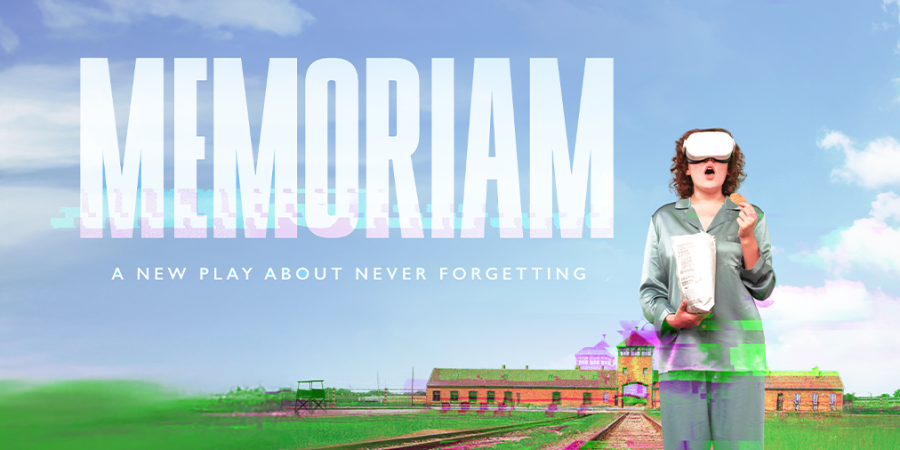
In a not-too-distant future, a company called Memoriam has developed technology capable of extracting people’s memories and allowing others to experience them firsthand. Customers can enter another person’s recollections through a sophisticated sensory process, opening up extraordinary possibilities for entertainment, education and the preservation of history. But when memories become a commodity, who decides what happens to them?

Rachel (Rachel Barry) works for Memoriam, where her ambitious boss Chris (Ben Wiggins) sees an extraordinary commercial opportunity in her grandmother Rivka (Beverley Klein), a Holocaust survivor whose memories could become an invaluable resource. With Rachel under considerable pressure at work, persuading Rivka to participate becomes increasingly important. Yet her brother David (Ashley Margolis) is fiercely opposed, believing that their grandmother’s experiences are hers alone and that her wishes must be respected.

What follows is an absorbing exploration of competing loyalties and uncomfortable moral questions, brought vividly to life by an exceptional cast.

Beverley Klein is quite wonderful as Rivka. Her performance is so effortless, her comic timing so assured, that she has the audience in the palm of her hand almost from her first appearance. The smallest gesture can provoke laughter, and she gives Rivka an irresistible warmth and mischievous spirit. Yet beneath the humour is a woman carrying memories of unimaginable suffering. Klein never allows Rivka to become merely a symbol of the Holocaust; she is first and foremost a grandmother, fiercely individual, affectionate, funny and entirely capable of speaking for herself.

That distinction is crucial to the play’s central conflict. David, played with tremendous conviction by Ashley Margolis, is almost incandescent in his opposition to the proposed extraction. His anger is understandable. Rivka has expressed her reluctance, and surely that should be enough? Margolis captures both the intensity of David’s protectiveness and the frustration of watching his sister become increasingly entangled in the company’s ambitions. Their arguments feel entirely authentic, rooted in recognisable sibling dynamics rather than simply serving as vehicles for opposing viewpoints.

Rachel Barry is equally convincing as a young woman caught between her family and her career. Rachel is not heartless or indifferent to her grandmother’s suffering. She is ambitious, frightened of losing her job and desperate to satisfy a demanding employer. Her predicament is painfully recognisable, even as her decisions become increasingly difficult to defend. Ben Wiggins is excellent as Chris, a wonderfully amusing embodiment of corporate enthusiasm and commercial tunnel vision. He is not malicious, merely so consumed by the possibilities of the product that he seems unable to grasp the human reality behind it. Jimena Larraguivel is equally entertaining as Becky, delivering some terrific one-liners with impeccable comic timing. Yet her character also exposes the more disturbing implications of the technology. Beneath the humour lies a stark reminder that these are not simply experiences to be bought and sold, but integral parts of people’s lives.

The premise inevitably recalls other explorations of memory and identity, from the Pensieve in Harry Potter to the unsettling science fiction of Blade Runner. Yet Flaishon gives familiar territory a compelling twist. Here, the technology is represented by strange white oval masks through which a customer connects with a ‘provider’s’ memories. Ellie Wintour’s strikingly simple white oval stage provides an appropriately futuristic setting, while Jonathan Chan’s lighting and Sarah Spencer’s sound design help create a world that feels both fantastical and disconcertingly plausible.

Flaishon and director David Goldman are particularly effective when confronting the audience with the devastating emotional consequences of accessing another person’s trauma. Through atmospheric sound, lighting and a remarkable physical performance from Rachel Barry, one especially powerful sequence communicates the almost unbearable weight of memories that can never truly be understood by those who did not live through them. The restraint of the staging makes the moment all the more affecting.

And therein lies the play’s most troubling question. There is an undeniable importance in preserving the testimony of Holocaust survivors, particularly as the generation who experienced those atrocities passes away. We must remember, and future generations must understand. But does that justify pressuring an individual to surrender their most traumatic memories? And what happens when those memories are edited, embellished or repackaged to make them more commercially appealing?

As a lawyer who deals with intellectual property, I found this aspect particularly fascinating. The prospect of memories becoming assets to be licensed, manipulated and exploited raises all manner of questions about ownership, consent and control. Once a memory has been extracted and shared, can its original owner ever truly reclaim it? Even if a contract grants the necessary rights, does that make the transaction morally acceptable? Flaishon cleverly exposes the gulf that can exist between what is legally permissible and what is ethically right.

There is also something especially uncomfortable about the suggestion that suffering might be made more palatable, even romanticised, for an audience. Rivka’s memories are not a screenplay awaiting improvement. They are her lived experiences, and their authenticity is inseparable from their horror.

Goldman’s direction handles these difficult themes with considerable sensitivity, never losing sight of the relationships at the heart of the story. His programme notes reveal that his own grandmother survived the Holocaust and later chose to share her testimony with her family and others. That personal connection lends an additional poignancy to a production so concerned with how memories are preserved, passed on and understood.

If there is a criticism, it concerns the occasional loss of dialogue in the theatre’s in-the-round configuration. During a particularly poignant sequence in which Rivka circles the white oval stage, recounting her memories in her own words, Klein’s voice sometimes drops or is directed away from sections of the audience. From my seat, some of this important testimony was difficult to hear, which was a real shame given the significance of the moment. It is a relatively minor reservation about an otherwise beautifully performed production, but one worth addressing.

What makes Memoriam so successful is that it never becomes a dry philosophical debate. It is consistently entertaining, frequently very funny and populated by recognisably human characters whose motivations, however questionable, are rarely difficult to understand. The performances throughout are grounded in an appealing naturalism that makes the speculative premise entirely believable.

Ultimately, Memoriam is a play about much more than technology. It is about the responsibility of remembering, the right to decide what we share and the extraordinary power of stories passed between generations. In an age when artificial intelligence and immersive experiences are advancing at astonishing speed, its questions feel particularly urgent.

Thought-provoking, beautifully acted and often unexpectedly moving, Memoriam is an accomplished piece of contemporary theatre that stays with you long after the lights go down.  

Memoriam continues its run at Southwark Playhouse, Borough, until 21 November 2026 with tickets available here: Memoriam – Southwark Playhouse Borough

Dog Mom @ Southwark Playhouse, Borough – October 2026

UTS Rating: 🎭🎭🎭

They say a dog is man’s best friend, but what happens when our four-legged companions become rather more than that? A source of comfort, companionship, unconditional love and, sometimes, the very thing that keeps us going?

Written by Tate Elizabeth Hanyok and presented by EnActe Arts in association with Riding Lights, Dog Mom is a quirky, affectionate comedy exploring the extraordinary bond between humans and their animals. It’s funny, fluffy, occasionally frustrating and ultimately rather touching.

At the centre of the story is Sarita (Vinita Belani), a woman navigating the complications of life, relationships and expectations, who finds companionship and purpose through her relationship with her newly adopted dog, Foster. Belani gives a competent, understated performance, providing a relatively grounded presence amid the more exuberant personalities surrounding her.

And exuberant they certainly are! Patty Gallagher is quite superb as Foster, bringing her extensive experience in clowning and physical theatre to bear in a wonderfully observed portrayal. From the smallest mannerisms to the broader canine antics, she captures something instantly recognisable to anyone who has ever shared their home with a dog. It’s a first-class piece of physical comedy, frequently hilarious and thoroughly endearing.

Along the way, Sarita encounters an assortment of colourful characters, both human and canine, who help her discover that family, love and belonging can take many different forms. Tom Barnes is particularly enjoyable as Ruben, another canine companion, as well as Sarita’s ex-husband, Clay. His portrayal of Ruben is clever, funny and rather sweet, with an almost studied attention to canine behaviour that makes the character strangely believable. The physical skill involved in these performances is considerable, and both Barnes and Gallagher deserve enormous credit for making such an unlikely theatrical concept work.

The production also benefits enormously from the versatility of Jarreau Antoine, who slips effortlessly between a succession of supporting characters, bringing energy, humour and some wonderfully exaggerated characterisations to the stage. One particularly flamboyant canine creation reminded me of those gloriously pampered, rather superior poodles from old Disney cartoons. He’s terrific fun to watch, and it’s easy to see why his performance has attracted such praise.

But beneath the canine comedy lies something rather more thoughtful. One of the play’s central themes is the importance of finding your pack, those people, and animals, who understand us, support us and make us feel that we belong. Sometimes that pack consists of family, sometimes friends, and sometimes the furry creatures who share our homes and lives. Dog Mom reminds us that our pack needn’t look like anyone else’s, and that finding it can make all the difference.

This idea is particularly beautifully expressed through Nell (Joanna Holden), an interfering, opinionated New Yorker who initially comes across as rather irritating but gradually reveals herself to be one of the most compassionate and perceptive characters in the play. Holden captures the busybody exterior wonderfully, but it’s the warmth beneath it that ultimately makes Nell so memorable.

Indeed, one of the most affecting moments of the evening comes when Nell reassures Sarita that having children is not the only route to a meaningful, loving and fulfilling life. There are different ways to nurture and care, and the love we give to our animals is no less genuine simply because they happen to have four legs rather than two.

What makes the speech particularly lovely is that Nell is herself a mother, yet recognises that motherhood is neither a requirement nor the defining achievement of womanhood. As someone without children myself, I found this especially resonant. It’s a beautifully delivered moment, full of empathy and understanding, and a reminder that sometimes the quietest exchanges in a play can carry the greatest emotional weight.

Nell also becomes part of Sarita’s own expanding pack, offering friendship, support and some unexpectedly sensible advice. The play suggests that belonging isn’t necessarily something we’re born into. Sometimes it’s something we create for ourselves, one relationship at a time.

The theme of animals rescuing their humans as much as the other way around is, of course, hardly new. The extraordinary true story of James Bowen and A Street Cat Named Bob brought this very idea to a huge audience, demonstrating how the companionship of an animal can transform a person’s life. But Dog Mom finds a fresh and often very funny theatrical way of exploring that familiar emotional territory.

And perhaps that’s where its greatest charm lies. We talk endlessly about rescuing animals, giving them homes, safety and affection, but how often do we stop to consider just how much they give us in return? For those facing loneliness, loss or simply the everyday challenges of life, an animal can provide a sense of purpose, routine and unconditional love that is difficult to replicate.

All of that said, the production isn’t without its shortcomings. As accomplished as the canine performances undoubtedly are, the novelty does begin to wear a little thin as the evening progresses. What initially feels wonderfully inventive and charming becomes somewhat repetitive in the second half, and I found myself becoming just a touch irritated by the continuing doggy antics. There’s only so much canine capering one can enjoy before wishing the story would move along a little.

I also felt that the ending rather overplayed its emotional hand. Having established such a lovely, thoughtful message about companionship and the different forms that love can take, the play ultimately resorts to a fairly predictable tug at the heartstrings. It felt a little calculated, and I couldn’t help wishing the writer had trusted the emotional strength of the story without quite so much encouragement for us to reach for the tissues.

My companion, a devoted dog mom herself, was nevertheless in floods of tears by the end, so it certainly achieved its intended effect! And perhaps that illustrates something important about the production: its emotional impact will depend considerably on the experiences and attachments that each audience member brings with them.

There’s nothing particularly remarkable about the staging or design, and this isn’t a production that breaks new theatrical ground in its storytelling. But nor does it really need to. Its pleasures are simpler: accomplished performances, affectionate humour, recognisable characters and a message that will strike a chord with animal lovers everywhere.

Dog Mom isn’t a literary masterpiece, and it doesn’t pretend to be. It’s a charming, entertaining and occasionally moving piece of theatre that celebrates the extraordinary relationships we form with our animals, while gently challenging the idea that love, family and fulfilment must follow a conventional path.

Sometimes theatre doesn’t need to change the world. Sometimes it just needs to make us smile, recognise something of ourselves and perhaps appreciate our furry companions that little bit more.

A sweet, funny and thoroughly likeable evening, with plenty of heart, even if it occasionally lays the puppy-dog eyes on a little too thick.

Dog Mom runs at Southwark Playhouse, Borough, until 7th November, which tickets available here: Dog Mom – Southwark Playhouse Borough

As You Like It @ Shakespeare’s Globe, London – October 2026

UTS Rating: 🎭🎭🎭🎭

Shakespeare’s Globe is always a rather special place to experience the Bard’s work, and this vibrant, imaginative production of As You Like It is a thoroughly enjoyable evening of romance, comedy and glorious theatrical invention. Bursting with colour, music and some wonderfully engaging performances, Sean Holmes and Charlie Josephine’s interpretation brings Shakespeare’s pastoral comedy to life with considerable charm.

The story follows Rosalind, daughter of the banished Duke Senior, who is forced to flee the court of her usurping uncle, Duke Frederick. Accompanied by her devoted cousin Celia and the court fool Touchstone, she escapes to the Forest of Arden, disguising herself as a young man named Ganymede. There she encounters Orlando, with whom she has already fallen in love, and proceeds to test his affections without revealing her true identity. Add several more romantically entangled characters, a little mistaken identity and a healthy dose of Shakespearean wit, and the stage is set for a delightfully complicated comedy.

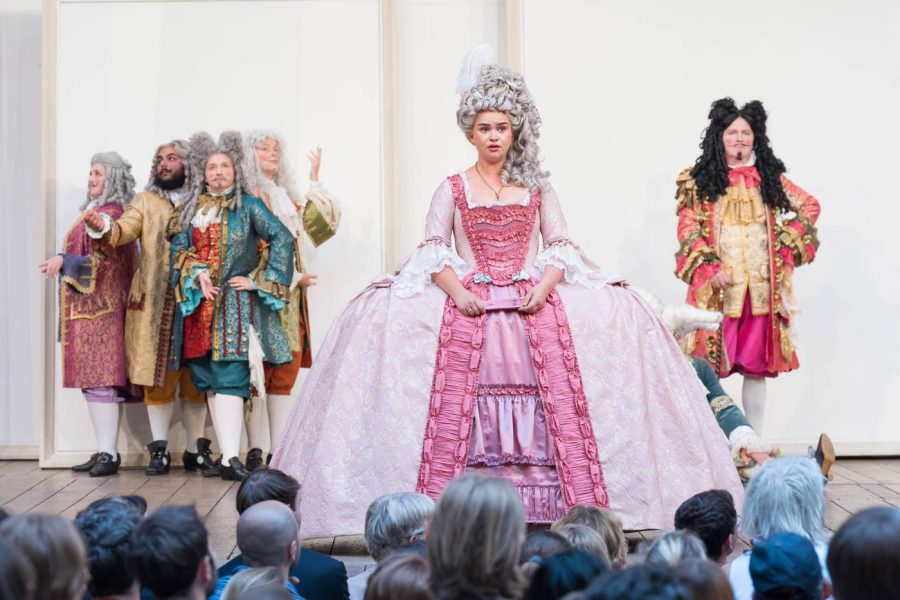
Visually, this production is a treat. The opening court scenes are a riot of extravagant costumes, towering wigs and colourful finery, with Rosalind and Celia particularly striking in their contrasting pink and blue dresses, almost like matching bookends to the action. Designer Paul Wills draws inspiration from the extravagance of the late 17th and 18th centuries, creating a wonderfully flamboyant courtly world. The transition to the Forest of Arden, however, is where the design really comes into its own.

Rather than presenting us with a conventional woodland setting, Wills employs a largely blank backdrop which gradually comes to life as trees and foliage are drawn and painted across it. It’s a wonderfully simple but effective concept, allowing the forest to grow before our eyes. As romance blossoms, splashes of red flowers appear among the branches, a lovely visual reflection of the relationships developing beneath them. The Globe itself becomes part of the canvas, with images projected onto its walls, adding another layer of theatrical magic. Credit must also go to scenic artist Emily Carne for her contribution to this striking visual world. It’s inventive, playful and beautifully suited to the space.

Music is another considerable strength. Katie Richardson’s compositions, performed by a talented group of live musicians, lend the production a warmth and energy that complement the action beautifully. Richardson herself provides vocals and guitar (I want that white one!!), and the delightful singing and rich harmonies are among the evening’s highlights. Rather than feeling like an interruption, the musical interludes become an integral part of the storytelling, contributing enormously to the atmosphere. The celebratory finale is particularly enjoyable.

Cast wise, Lola Shalam makes a terrific Rosalind, capturing both her intelligence and playful wit. Her transformation into Ganymede is convincing and entertaining, and she handles Shakespeare’s language with assurance. Rosalind is very much the driving force of the play, and Shalam brings an appealing combination of confidence, humour and vulnerability to the role.

Charlie Josephine delivers a wonderfully unconventional Orlando, bringing an unexpected Cockney swagger and an appealingly eccentric, slightly bumbling quality to the role. It’s certainly not the romantic hero one might anticipate, and the characterisation initially takes a little getting used to, but Josephine’s assured performance makes this unusual interpretation both entertaining and rather endearing.

Gracie Oddie-James is a likeable Celia, and the affection between the cousins is evident, although her vocal projection occasionally lets her down. The Globe is an unforgiving space for quieter voices, with no amplification to fall back on, and even from the lower-level seating some of Celia’s dialogue was difficult to hear. It’s a shame, as her relationship with Rosalind is such an important element of the play.

Katherine Pearce impresses as the melancholy Jaques, providing a welcome contrast to the romantic exuberance surrounding her. Her delivery of the famous ‘All the world’s a stage’ speech is a particular highlight, reminding us that beneath the comedy lie some rather more thoughtful observations about life, ageing and the human condition.

And then there’s Charles the wrestler, played by Jurell Carter. The wrestling sequence is great fun, but I confess that when Carter removes his top, his rather magnificent physique threatens to upstage the action entirely. My friend leaned over and whispered, ‘I hope you give him a good review.’ Well, consider it done! A most memorable appearance, in more ways than one (his acting ain’t half bad, either 😉

For me, however, one of the evening’s greatest delights is Jonnie Broadbent as Touchstone. His comic timing, wonderfully expressive delivery and effortless interaction with the audience make him an absolute joy to watch. He commands attention whenever he appears, and his scenes with Phoebe Naughton’s Audrey are particularly entertaining. There’s a real art to making Shakespeare’s humour feel spontaneous and accessible, and Broadbent achieves it splendidly.

The production makes excellent use of the Globe’s unique relationship between performers and audience, with plenty of physical comedy, lively exchanges and moments of direct engagement. The romantic complications involving Silvius (Busa Wickramasuriya) and Phebe (Molly Madigan) provide further amusement, while the various reconciliations and revelations build towards a joyous conclusion.

Not every performance is equally assured, and there are occasional moments when the exuberance threatens to overshadow the subtler emotional nuances of the play. Yet these are relatively minor reservations in a production that succeeds so wholeheartedly in entertaining its audience.

I often wonder what Shakespeare would make of the fact that, more than 400 years later, we’re still performing, dissecting and endlessly discussing his plays. As You Like It is one of his best-known and most frequently performed comedies, and while there’s no shortage of themes and symbolism for academics to pore over, I can’t help feeling that Shakespeare was simply having a bit of a laugh when he wrote it and the same for many of his other comedies. All those disguises, mistaken identities, unlikely romances and gloriously improbable happy endings! Would he be astonished by the endless interpretations and analysis of his work, or thoroughly amused by it all? I suspect the latter. And perhaps that’s part of the enduring appeal. Four centuries on, we’re still laughing at his jokes.

As You Like It continues at Shakespeare’s Globe until 25th October with tickets available here: As You Like It | Summer 2026 | What’s On

Powered by WordPress & Theme by Anders Norén