
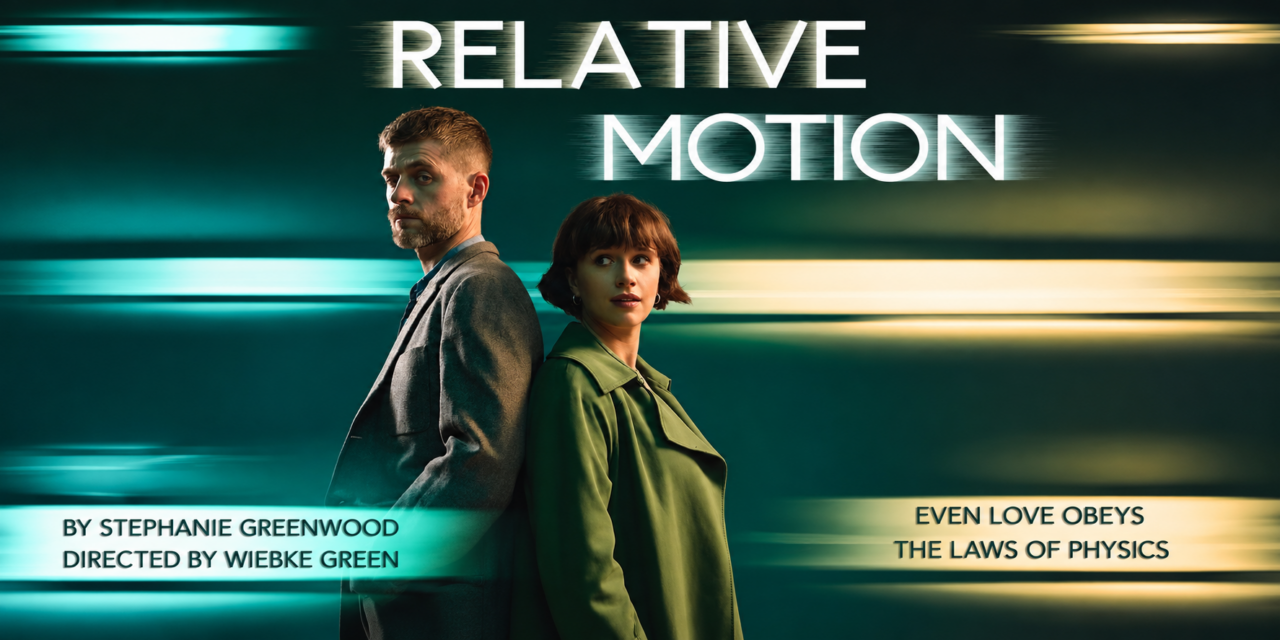
Southwark Playhouse Borough | 17 November 2026
UTS Rating:  (4/5)
There are some plays that entertain you, some that make you think, and others that leave you feeling distinctly uncomfortable. Relative Motion, Stephanie Greenwood’s compelling new play at Southwark Playhouse Borough, falls firmly into the latter category. Not because it is particularly shocking or sensational, but because it is so frighteningly believable.
Sam (Stephanie Greenwood) is an intelligent, ambitious young physicist with a promising career ahead of her. Paul (Sean Hart) is a dishevelled, charming, artistic writer. They meet on a train platform, and there is an immediate attraction. He is funny, engaging and apparently thoughtful. She is bright, enthusiastic and full of life. What could possibly go wrong?!
Quite a lot, as it turns out.
Their relationship develops quickly. Paul declares his love almost immediately, and before long they are making plans for a future together. But the warning signs are there from the very beginning. Even during a very early encounter, he questions why Sam wants to leave him to catch her train rather than spend another three minutes in his company. It seems almost playful at first, but it is an early glimpse of the possessiveness that will come to dominate their relationship.
As the story unfolds, Paul’s behaviour becomes increasingly troubling. He accuses Sam of flirting with his friends when she is simply being friendly, questions her commitment to him and finds fault with seemingly innocent remarks. When she apologises, often repeatedly, he withdraws his affection, ignores her calls and messages, and leaves her wondering what she has done wrong.
And then, just when we are ready to write him off completely, he becomes the lovely, supportive, understanding man she fell in love with.
It is this constant switching between affection and cruelty that makes Paul’s character so convincing, and so unsettling. His behaviour is not always overtly aggressive. Sometimes it is subtle, almost imperceptible, leaving Sam questioning her own judgement and apologising for things that were never her fault in the first place.
Meanwhile, Sam has rather more important things to contend with. She is grieving the death of her mother, facing challenges surrounding her own health and future, and trying to pursue her academic ambitions. Yet, somehow, she finds herself devoting an extraordinary amount of emotional energy to managing Paul’s moods and insecurities. Even the day of her mother’s funeral becomes the occasion for another confrontation.
Greenwood’s writing captures the insidious nature of coercive control with remarkable authenticity. As the gentleman sitting next to me observed afterwards, “It’s that drip, drip, isn’t it?” And he was absolutely right. It is the accumulation of seemingly minor incidents, the constant questioning, the misplaced guilt, the apologies for things that were never her fault, that gradually erodes Sam’s confidence. No single incident necessarily seems catastrophic in isolation, but together they create something deeply damaging.
This is not a simplistic portrait of a villain and his victim. Paul can be genuinely appealing, and Sam is certainly no shrinking violet. She is successful, articulate, independent and intelligent. But none of those qualities makes someone immune to emotional manipulation.

Indeed, that is perhaps the most powerful aspect of the play. For anyone who has encountered this kind of relationship, whether personally or through someone close to them, there will be moments of uncomfortable recognition. I suspect that many in the audience felt the same. By about half an hour in, I think most of us wanted to throttle Paul ourselves.
Sean Hart is excellent as Paul, making him infuriatingly believable without ever turning him into a caricature. His charm is entirely credible, which is essential if we are to understand why Sam falls for him and, more importantly, why she stays. His ability to shift almost instantaneously from warmth and vulnerability to jealousy and coldness is particularly impressive.
Greenwood is equally compelling as Sam. She portrays a woman who begins the relationship confident and full of optimism, but gradually finds herself second-guessing her own behaviour. Her performance is beautifully natural, and the frustration of watching such a capable woman become increasingly entangled in Paul’s emotional games is almost unbearable.
Together, the two actors create an absorbing and often painfully recognisable relationship. One particularly impressive sequence sees Sam travelling home on a train, speaking to her sister on the phone, while Paul, on the other side of the stage, desperately tries to contact her. Having previously subjected Sam to days of silence, he now finds himself on the receiving end. The rapid exchanges are brilliantly written and impeccably timed, requiring considerable precision from both performers. It’s a wonderfully effective piece of theatrical storytelling.
Directed by Wiebke Green, the production is strikingly minimalist. The stage is essentially a black floor with a handful of movable blocks, which are rearranged to suggest different locations. It is an effective approach, keeping our attention firmly on the characters and their changing relationship.
Physics is woven cleverly into the narrative, reflecting Sam’s profession and providing a metaphor for the forces at work between the couple. At various points, she writes equations in chalk across the blocks and stage floor, a device that reminded me of The Curious Incident of the Dog in the Night-Time. The scientific language of motion, momentum and opposing forces becomes an unexpectedly fitting way of exploring the complexities of human relationships.
At around 75 minutes without an interval, Relative Motion is tightly constructed and never loses its audience’s attention. If anything, I would have welcomed a little more time for the relationship to develop and for some of its complexities to be explored further. But there is something to be said for the intensity of a single, uninterrupted act, particularly with material as emotionally demanding as this.
The closing scenes are especially effective, offering an intriguing moment of ambiguity and a wonderfully unexpected burst of laughter from the audience. It is a clever release of tension after what has been, at times, a deeply uncomfortable experience.
Reading Greenwood’s programme notes afterwards, I was interested to discover that the play was originally conceived in 2018 and developed from her fascination with Newton’s laws of motion as a way of understanding human relationships. She describes the difficulty of finding satisfactory explanations for why people hurt one another, and the temptation to look for something more tangible in the laws of physics. It is a fascinating starting point for a play that ultimately demonstrates just how unpredictable human behaviour can be.
There is a nice personal connection for me, too. Feuille Dooley Productions, who are associated with this production, were also behind I Was a Teenage She Devil, the very first show I reviewed when I returned to theatre reviewing earlier this year. It is a pleasure to encounter their work again, albeit in a very different form.
Relative Motion is an intelligent, perceptive and superbly acted exploration of a relationship that becomes increasingly destructive. Its greatest strength lies in its restraint. It does not need melodrama or sensationalism to make its point. Instead, it shows how easily affection can become possession, how manipulation can masquerade as love, and how difficult it can be to recognise what is happening when you are caught in the middle of it.
Uncomfortable, compelling and all too recognisable, this is a powerful piece of theatre that deserves to be seen.
Relative Motion continues its run at Southwark Playhouse Borough until 5 December 2026, with tickets available here: Relative Motion – Southwark Playhouse Borough
Photos by Simon Annand and Rich Lakos.
Leave a Reply